
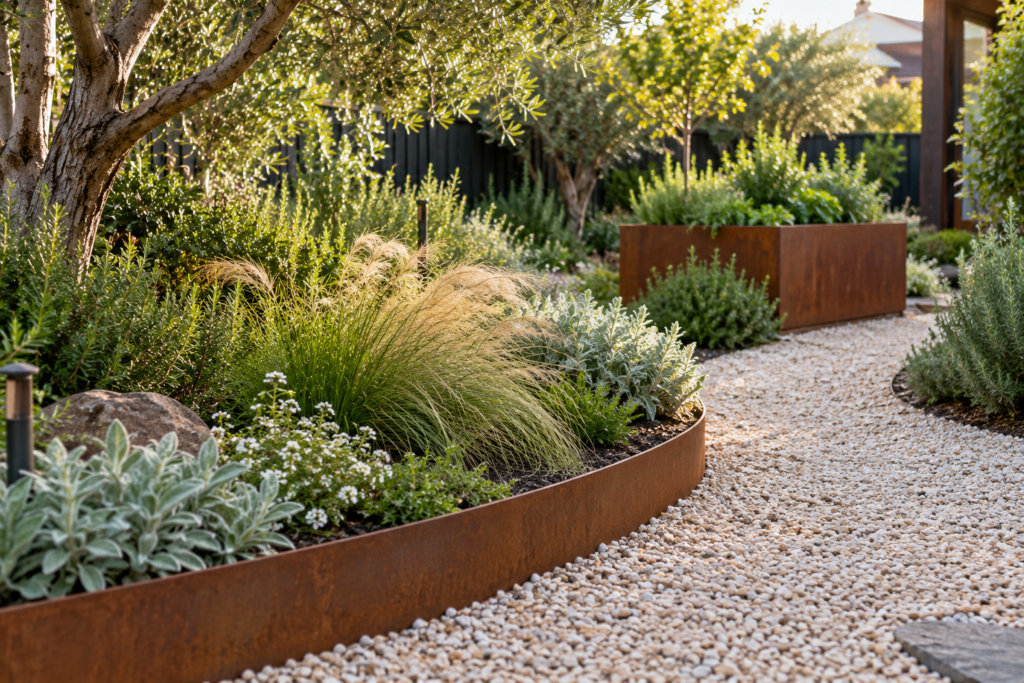
A garden can feel disjointed when lawn edges, planting areas and outdoor living spaces lack a clear relationship. Using corten garden edging can introduce a consistent boundary that helps connect those different areas. The layout still needs to suit the way people move through and maintain the space. A corten planter box can bring planting into a courtyard or beside a seating area without requiring a complete garden redesign. Repeating the same material in a few carefully chosen places can create continuity without making every feature identical. For households planning a productive growing area, corten raised garden beds offer another way to carry that finish through the landscape while giving vegetables and herbs a defined space.
Start with the Layout, Then Choose the Height
Before selecting materials, it helps to identify what each boundary needs to achieve. Separating lawn from mulch is a different task from containing a deep planting bed. The height, fixings and support requirements should reflect that purpose.
Low profiles can provide a discreet division between surfaces, while taller sides make planting areas more prominent. However, a product intended for a simple border should not automatically be treated as suitable for retaining a substantial depth of soil. Manufacturer specifications should guide the choice.
Marking the proposed layout with a garden hose or string allows the shape to be assessed before installation. This also reveals awkward corners, narrow passages and curves that look appealing on paper but leave little room for mowing or moving a wheelbarrow.
Straight boundaries often work well alongside paving and building lines. Curves can soften a lawn or guide movement around a planting area, provided they leave enough usable space on both sides.
Plan for the Changing Finish
Weathering steel develops a rust-coloured surface patina rather than maintaining a uniform painted appearance. Newly supplied material may look dark initially, with colour developing unevenly as it weathers. The process can take weeks or months, depending on conditions, so an immediately consistent finish should not be assumed.
That changing appearance is part of the material’s visual character. Its earthy tones can sit comfortably beside timber, gravel and green foliage, although a restrained material palette usually makes the relationship clearer.
Positioning deserves particular attention near pale paving or concrete. Rust runoff can cause staining during the early weathering stages, making surrounding surfaces and water movement important installation considerations. Product-specific guidance can help determine whether preparation before installation is appropriate.
Make Planting Areas Practical to Use
A raised growing area works best when its dimensions suit the person maintaining it. Beds accessible from both sides can be wider than those positioned against a fence, but the centre should remain comfortably within reach.
Paths also need enough clearance for ordinary jobs. Carrying a watering can, kneeling beside plants and moving compost become frustrating when access is squeezed between oversized beds. Planning the paths alongside the planting area avoids treating them as leftover space.
The intended plants should guide soil depth and placement. A shallow herb display has different requirements from a bed intended for larger vegetables or permanent shrubs. Sunlight, mature plant size and access to water all deserve consideration before the structure is filled.
For containers positioned on paving, drainage outlets need somewhere suitable to discharge. On balconies or elevated decks, the combined weight of the structure, wet growing medium and plants should be checked against the space’s load capacity.
Resolve the Installation Details Early
A neat result depends on more than the visible top line. Ground preparation, secure connections and suitable anchoring help the finished boundary follow the intended shape.
Corners and joins deserve close inspection, particularly beside paths or play areas. Products with finished top edges can help provide a more comfortable contact surface, but cut sections and exposed fixings still need attention during installation.
Irrigation is easier to plan before soil and mulch are added. Leaving access to connections and directing water towards the planting area can reduce the need to disturb an established bed later.
Maintenance access matters just as much as appearance. Lawn edges should allow room for the equipment used to cut them, while planting beside a path should leave space for foliage to mature without blocking the route.
A cohesive garden combines clear boundaries, practical planting spaces and room to move, with each material chosen to support the way the space is used.